A garden fence is the first boundary of a home or business: security, privacy, safety for children and pets, and the first impression of the façade all pass through it. Metal is one of the most widely used choices for its strength, slim good looks and easy upkeep. But a good-looking fence with weak anchoring, poor surface protection or a wrong wind calculation can lean and rust within a few years. This guide covers the models, materials, height and permission questions, wind and foundations, sloping ground, pool safety and what drives the price.
Short answer: Three things decide a metal garden fence: (1) the right model (vertical bars, slats, laser-cut or solid panel) and height, (2) posts, foundations and anchoring suited to wind and ground, and (3) surface protection suited to the climate (galvanising plus electrostatic powder coating) and accurate measuring and installation. Zoning and neighbour matters should be settled first; the price is the sum of these choices.
Metal fence models: which one, and where?
“Metal fence” is a family that varies with privacy, security and looks:
| Model | Where it is used | Character | Points to watch |
|---|---|---|---|
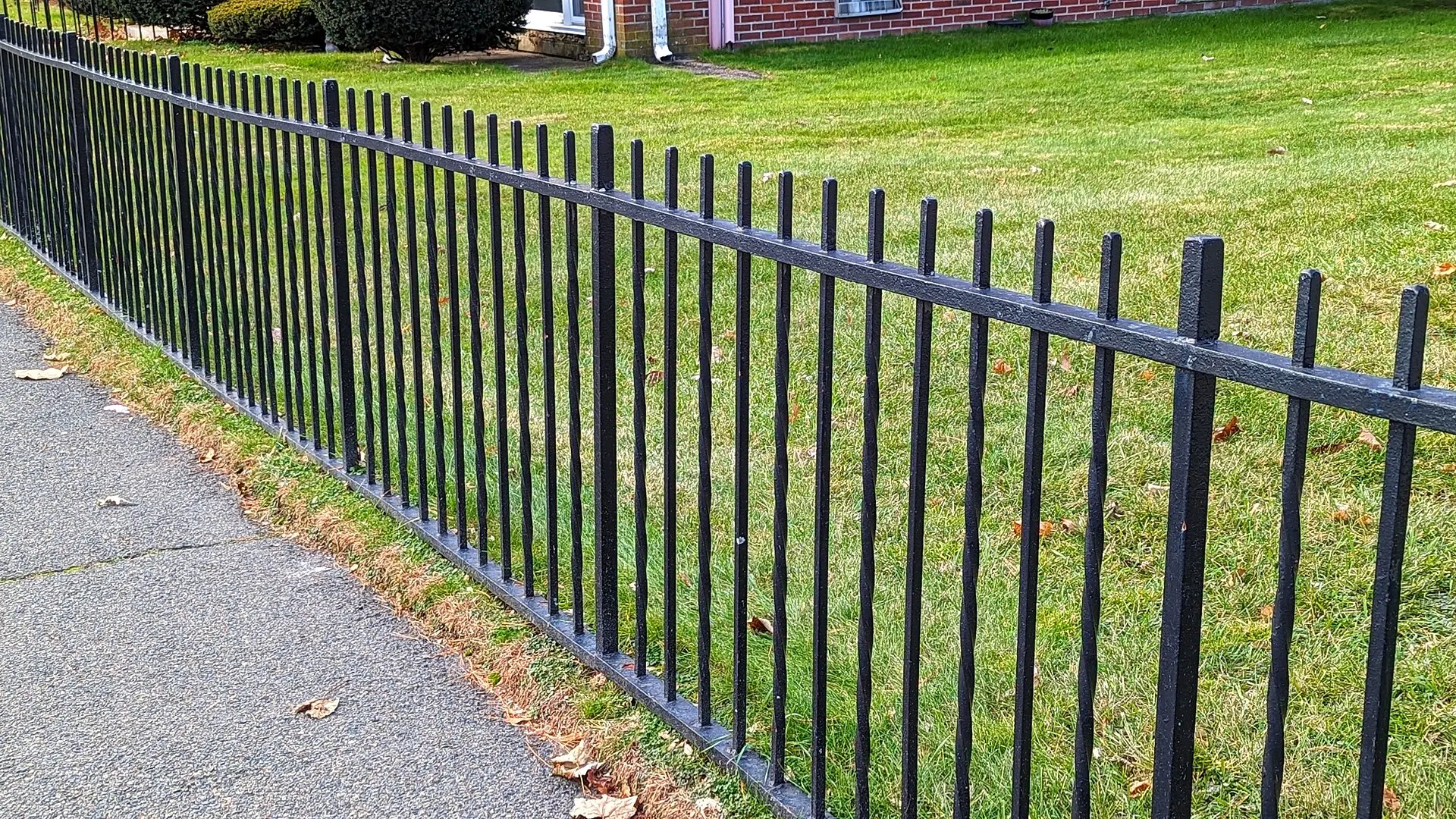
| Vertical-bar (classic) fence | Detached homes, gardens, estates, schools | Looks light, lets air and light through, little wind load | Bar spacing, climbing, paint |
| Slatted fence | Gardens and terraces needing privacy | Both privacy and airflow | Slat spacing, wind, anchoring |
| Louvred (angled-slat) fence | Villas, road frontage | Visual screen, ventilation | Slat angle, wind |
| Laser-cut patterned panel | Villa entrances, decorative façades | Play of light and shadow, distinctive design | Plate thickness, pattern density, cut-edge coating |
| Solid plate panel fence | Full privacy, noise control | Strong privacy | Highest wind load; strong posts and footings |
| Wrought-iron (ornamental) fence | Classic façades, historic areas | Rich motifs, character | Paint and upkeep of detailed surfaces |
| Fence + gate + pedestrian gate set | All garden entrances | Same line, unity | Style match; stronger gate posts |
You can see our range on the garden gates page and examples in the gallery.
Height, appearance and privacy: how to decide
- Road frontage: often a light bar fence or spaced slats keep the façade open and welcoming.
- Neighbour boundary: for privacy, slats, louvres or solid panels; but also think of the neighbour’s view and light.
- Rear garden and side boundaries: usually taller and more closed models are chosen.
- Security: a structure that is hard to climb, with a safe top detail and height; gaps limited for children and pets.
- Noise: solid panels reduce traffic noise and may be considered along busy roads.
A common height in home gardens is about 1.0–2.0 m; the exact height is set by the zoning decision.
Material and profile
| Material | Strength | Weakness | Works well in |
|---|---|---|---|
| Painted steel | Strong, economical, fits any form | Rust starts if the paint is damaged | Sheltered places; regularly maintained sites |
| Galvanised + electrostatic powder coat | Steel strength + zinc protection | Higher cost | Outdoors, coast, long-life expectations |
| Stainless steel | Very high corrosion resistance | Costly, harder to work | Coast, pool surrounds, special designs |
| Aluminium | Light, rust-free | Limited in load and span | Light slatted and louvred fences |
In practice: galvanising plus electrostatic powder coating outdoors and near the coast; around pools and in damp, chlorinated areas the surface quality and material choice matter even more.
Wind, posts and footings: what keeps a fence standing
A fence that leans is usually a post and footing problem, not a profile problem:
- Wind load: a solid or tightly slatted fence catches wind like a sail. On the coast and open ground (for example Urla, Çeşme, Güzelbahçe), post section, spacing and footings must be calculated accordingly. A light bar fence has far less load.
- Post spacing: generally about 2–3 m, set by model, height and wind.
- Footings: posts are set in concrete or fixed with base plates. Ground type, frost and water affect footing size.
- Fence on a wall: check the capacity and thickness of the existing wall; use chemical anchors and plate fixings.
- Do not rely on rough figures: these values are general practice; the exact calculation is done on site, project by project.
Sloping ground, corners and gates
- Sloping ground: the fence may rise with the slope or be stepped in stages. Panel lengths and appearance are designed accordingly.
- Corners and turns: corner posts should be stronger; angled turns need accurate panel measurements.
- Gate and pedestrian gate: fence, gate and pedestrian gate should share the design and height; gate posts must be made stronger.
- Water flow: water and mud should not collect at the base; consider ground levels and drainage.
The base of the fence and rust: the commonest mistake
The most frequent cause of rust is the bottom edge touching soil or wet ground:
- Plinth: leave a concrete or stone plinth under the fence; the bars rise above the soil.
- Surface system: galvanising plus electrostatic powder coating (duplex) is advised outdoors.
- Details: welds, ends, plates and bottom edges coated evenly; no water trapped inside profiles.
- Maintenance: washing once or twice a year, touching up scratches and checking the area near the ground is enough; on the coast, more often.
Always ask in the quote: “Which primer and paint, in how many coats?” For corrosion detail see our steel railing guide.
Children, pets and pool safety
- Bar spacing: for children and small pets, gaps should not exceed about 10–11 cm.
- Climbing: horizontal bars and intermediate rails act as steps; where children are present, prefer vertical infill.
- Pool fence: around a pool the fence should be tall and unclimbable, and the gate self-closing and lockable. Check the safety regulations and municipal rules for pools separately.
- Dogs: set the bottom gap so animals cannot escape.
Permits and permissions: when are they needed?
The exact position depends on the municipality and zoning plan. In general:
- Zoning decision: plan notes may cover garden wall and fence height, transparency ratio and the road-facing side.
- Neighbour boundary: for a fence on a shared boundary, written agreement with the neighbour is advisable; a survey may be needed to fix the boundary correctly.
- Complexes and apartment blocks: a management or owners’ board decision may be needed for external or communal changes.
- Tenants: the owner’s written permission is needed.
- Protected and historic areas: consent from the relevant board may be required.
Get written information from the municipality and management before deciding; building a fence that needs permission without it can lead to removal and fines.
Thinking of fence, gate and railing as one line
A fence is not alone but part of a whole with gate, pedestrian gate, railings and façade:
- Same colour and line: when fence, gate and railing share a design language, the façade gains unity.
- Posts and gate leaves: gate hinge posts should be stronger than the fence.
- Motorised gate: if you plan one, fence and gate posts should be prepared for it from the start.
- Existing façade: a fence matched to the house colour, roof and frames looks like a continuation of the same line.
For gate choice see our metal door guide.
How İzmir’s climate and location shape the fence
İzmir means hot, dry summers, mild, wet winters, year-round humidity and sea salt on the coast:
- Coastal areas (for example Karşıyaka, Bayraklı, Narlıdere, Güzelbahçe, Urla): galvanising plus powder coat or stainless options are a must; frequent washing is advised.
- Inland areas (for example Buca, Bornova, Gaziemir): less salt, but damp and rain still stress the system.
- Holiday estates and villas with pools: coast proximity, pool safety and wind are assessed together.
- Country houses and large plots: on long fence runs, post spacing, footings and slope are the main cost items.
- Sun: dark paints fade over time; an outdoor-grade electrostatic powder coat matters.
Installation: sequence and detail
- Site measuring and setting out: the fence line, corners, gate positions, slope and boundaries are set out on site.
- Excavation and footings: post holes dug and concreted; the concrete must be left to cure.
- Panel fitting: posts set plumb and aligned, panels fixed.
- Touch-up: weld and screw points and any marks from installation are touched up.
- Checks: plumb, alignment, gate operation and strength are checked.
Having the same team measure, make and install reduces measuring errors and connection problems.
What determines the price?
- Length and height: total run and fence height.
- Model: bars, slats, louvres, laser-cut or solid panel.
- Material and profile: section, plate thickness, steel, stainless or aluminium.
- Surface treatment: paint or galvanising plus powder coat, special colours.
- Posts and footings: spacing, footing size, fixing to wall or ground.
- Gates and pedestrian gates: number, type and whether motorised.
- Ground and access: slope, hardness, transport and installation difficulty.
A single “fence price” seen online does not apply to your project. The items that set the price should be separate lines in the written quote. The same approach for railings is in our railing prices article.
Common mistakes
- Looking only at price: a cheap quote usually trims posts, footings or paint.
- Not calculating wind for solid panels: risk of leaning or falling in the first storm.
- Letting the bottom edge touch the ground: the commonest cause of rust.
- Not researching zoning and the neighbour boundary.
- Measuring from a photo: slope, corners and gate positions must be seen on site.
- Ignoring bar spacing and climbing: child and pet safety.
- Making gate posts as light as fence posts: the gate will sag in time.
8 questions to ask when requesting a quote
- What are the model, height and bar or slat spacing?
- What are the material, profile section and plate thickness?
- What are the post spacing, section and footing or anchoring detail? Was wind taken into account?
- What are the surface preparation, galvanising or primer and paint system (number of coats)?
- How is the bottom edge separated from the ground and drainage resolved?
- Are the gate and pedestrian gate included, and how are their posts made?
- Who measures, who installs? Does the quote include transport, excavation and touch-ups?
- What warranty, maintenance advice and after-sales support are offered?
The process with Ertürk Metal
- Discussion and photos: you send photos of the garden, the approximate length and your needs.
- Site measuring: fence line, corners, slope, gate positions and ground are assessed on site.
- Design and quote: model, material, colour and gate options are settled and a written quote is prepared.
- Workshop manufacture: panels and posts are made in our workshop in Buca and the surface treatment is applied.
- Installation and handover: our team installs footings, posts and panels on site, checks and hands over.
Manufacturing time depends on the length of fence, the model and workload; a firm time is given in writing once measurements and model are settled.
Ertürk Metal in İzmir and across Türkiye
Since 2007 Ertürk Metal has made fences, garden gates, railings, staircases, doors and metal structures in its workshop in Buca, İzmir. Across Türkiye our own team measures, delivers and installs. We also ship to France and install within roughly 200 km of Béziers. See our service areas page for details.
Send a photo of your garden and the approximate length through our contact page, on WhatsApp or by phone, and we will settle model and material options together.
Conclusion
A good metal garden fence combines the right model and height, strong posts and footings, climate-appropriate surface protection and clean installation. To get a fence that looks good and stays upright through the first storm and the years after, ask in writing for the model, height, footings and surface system before you decide, and settle zoning and the neighbour boundary first.
Related articles: Metal Door Guide for İzmir · Steel Railing Guide for İzmir · Pergola, Canopy and Metal Shade Guide
Frequently asked questions
How tall should a metal garden fence be?
In home gardens a height of roughly 1.0 to 2.0 m is common; the purpose decides it: a see-through decorative fence is lower along a road, while privacy or security calls for more height. The exact limit depends on the municipality's zoning decision, plan notes and the boundary with neighbours, so get written information from the planning office before manufacture.
Vertical bars or solid panels: which should I choose?
A vertical-bar fence looks light, lets air and light through and takes little wind; it also suits children and pets. A solid or slatted panel fence gives privacy and noise control but catches wind, so posts, anchoring and foundations must be stronger. Privacy needs, wind exposure, budget and look decide.
Does a metal fence rust, and how is it protected?
Steel rusts if not protected properly. A duplex system of galvanising plus electrostatic powder coating is recommended outdoors, and matters even more near the coast. The bottom edge of the fence must not touch soil or wet ground; it should stand on a plinth or concrete footing.
Do I need a permit for a fence?
It depends. Zoning plan notes may set rules on garden wall and fence height, transparency and the boundary; in complexes and apartment blocks a management or owners' board decision may be needed. Do not start manufacture without written information, and record any agreement with the neighbour on a shared boundary in writing.
What should I watch for with a pool fence?
For child safety, gaps should not exceed about 10 cm, the fence must not be climbable (no horizontal bars or large cut-outs), and the gate must be self-closing and lockable. Also check the safety regulations and municipal rules that apply to pools.
How is a fence built on sloping ground?
There are two methods: the fence follows the slope (inclined panels) or is stepped in stages. The choice depends on the slope, the look you want and gate positions. Site measuring and levels are essential.
What determines the price?
Length and height, the model (bars, slats, laser-cut, solid panel), material and profile thickness, surface treatment, post spacing and foundations, the number of gates and pedestrian gates, ground slope and installation conditions. Even for the same length the price can vary a great deal, so the items should be set out in the written quote.
Do you build fences outside İzmir or in France?
Yes. We make fences in our workshop in Buca, İzmir. Across Türkiye our own team measures, delivers and installs. We also ship to France and install within roughly 200 km of Béziers.