To protect a shop window overnight, to drive into your garage at the touch of a button, or to shade and secure your windows from outside in the summer heat, a motorised shutter is one of the most practical solutions. But two shutters that look the same can perform very differently because of the slat type, the motor, and the guide and box details. This guide covers the types, materials, motor and controls, security, insulation, measuring and installation, maintenance and what drives price.
Short answer: Three things decide a motorised shutter: (1) the right slat and material (steel or aluminium; plain, perforated or insulated), (2) a strong and safe motor and control system (including emergency release and obstacle detection), and (3) correct measuring, box and guide details and clean installation. Security, insulation and appearance are the sum of these choices, and so is the price.
Types of shutter: which one, and where?
“Shutter” is a family of products that vary by use:
| Type | Where it is used | Character | Points to watch |
|---|---|---|---|
| Rolling shop shutter | Shops, shopfronts, entrances | Rolls up vertically, takes little space, adds security | Slat type, security, shopfront visibility |
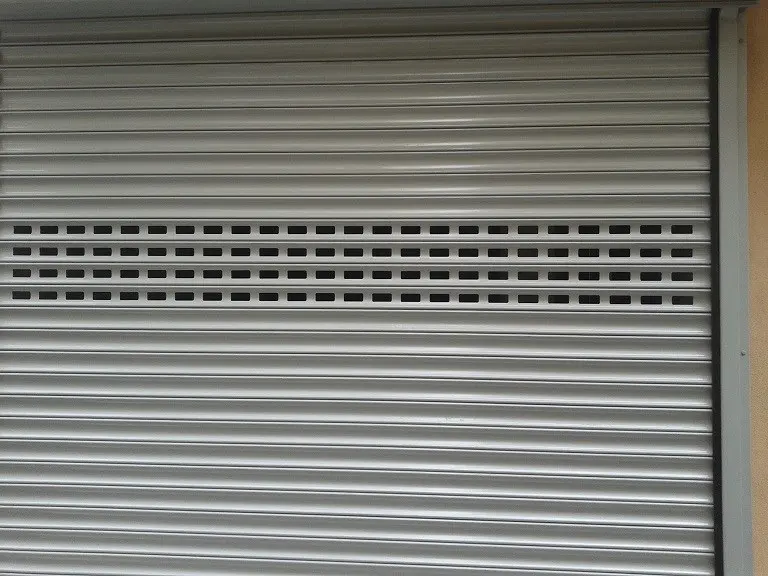
| Perforated / ventilated shutter | Shopfronts, car parks, storerooms | Ventilation and a view through | Security level, perforation type |
| Garage shutter | Detached homes, estate garages, depots | Opens quickly by motor, secure | Ceiling height, box position, motor power |
| Window shutter | Home windows, balcony doors | Sun, heat, sound and security | Box insulation, façade match |
| Insulated (filled) slat shutter | Where heat and sound matter | Better insulation and rigidity | Weight, motor selection |
| Custom and wide openings | Depots, workshops, commercial entrances | Solution for large spans | Shaft section, guide and motor calculation |
You can see our range on the motorised shutters page and examples in the gallery.
Material: steel or aluminium?
| Material | Strength | Weakness | Works well in |
|---|---|---|---|
| Steel (galvanised + paint) | Strong, economical, high security | Heavy; surface protection essential | Shops, depots, garages, wide openings |
| Aluminium | Light, rust-free, wide colour range | Limited for very heavy loads and very wide spans | Home windows, shopfronts, coast |
| Insulated (filled) aluminium or steel | Heat and sound insulation, strength | Heavier, higher cost | Where thermal comfort, sound and security are wanted |
| Transparent or perforated slat | Shows the shopfront, ventilates | Security depends on slat type | Shopfronts, car parks, open areas |
In practice: strong steel or insulated slats for shops and garages, aluminium or insulated aluminium for home windows. Ask which slat suits your application when you request a quote.
The parts: box, guides, slats, shaft, motor
Quality is not decided by the slats alone:
- Slats: the strips forming the surface; thickness, type and paint quality set appearance and strength.
- Shaft (axle): the tube the slats wind onto; its section must be calculated for span and weight, or it sags in the middle and overloads the motor.
- Box: the housing that holds the slats when open; it should be insulated, with an inspection hatch, and match the façade.
- Side guides: direct the slats; their depth and strength affect security and quiet running.
- Motor: tubular or shaft motor, sized for the weight of the shutter and how often it is used.
- Controls and sensors: remote, wall button, key switch, lock and obstacle detection.
Motor and controls: comfort and safety
- Motor power: chosen for weight, width and daily operations; a weak motor wears out early.
- Emergency release: a crank, chain or unlocking mechanism to open by hand if the power fails.
- Obstacle detection and safety: for commercial and garage-type motorised doors, product and operating-safety standards (such as TS EN 13241 and TS EN 12453) apply; ask for devices that reduce crushing and impact risk.
- Control options: remote, wall button, key, keypad or smart-home integration.
- Electrics: a power supply and fuse to the box must be planned in advance.
Important: Ask in writing for the safety devices and the emergency release method. They exist for user safety, not for show.
Security: what shops and garages need
A shutter protects as a system, not as one part:
- Slat thickness and type: strong, interlocking slats resist forcing better.
- Guide depth and fixing: guides firmly anchored in the wall prevent the shutter being pushed in.
- Motor and lock: a locked motor and floor locking protect against lifting.
- Shopfront security: it acts as a second barrier in front of the glass; perforated or transparent slats keep the display visible, but ask about the security level of that slat type.
- Insurance: some insurers require a given security standard; say so in the quote.
Heat, sound and sun control
- External sun protection: in İzmir’s hot summers, a shutter outside the window cuts the sun before it reaches the glass and keeps the room cooler.
- Insulated slats and box: reduce heat loss in winter; if the box is not insulated it becomes a thermal bridge.
- Sound: slat structure, guides and box detail affect noise; on traffic-facing façades, filled slats may be preferred.
- Light and ventilation: perforated and slotted options let light and air through.
If you are also replacing your windows, think of box and frame together. See our aluminium or PVC guide.
How İzmir’s climate affects a shutter
İzmir means hot, dry summers, mild, wet winters, humidity all year and sea salt on the coast:
- Coastal areas (for example Karşıyaka, Bayraklı, Narlıdere, Güzelbahçe, Urla): galvanising and quality paint on steel slats; quality surface coating and stainless hardware on aluminium. Wash and check more often.
- Inland areas (for example Buca, Bornova, Gaziemir): less salt; damp and rain still stress the system.
- Commercial districts (for example Konak, Alsancak): shopfront look and façade match matter; check building management and municipal rules, especially in protected historic areas.
- Wind: on the coast and open ground, slats, guides and box fixings must be sturdy for wind resistance.
Measuring and installation: where most mistakes happen
A shutter is made to size, so a small measuring error means remaking it:
- Site measuring is essential: width, height, box position, lintel condition, side-wall projections and sill must be recorded.
- Box position: inside or outside affects the façade look and the space lost.
- Guide depth and wall condition: guides must be fixed to sound surfaces; a weak wall needs an extra solution.
- Electrical preparation: power and control lines should be ready for the motor.
- Installation and adjustment: smooth, quiet travel, limit settings, emergency release and obstacle detection should all be tested after installation.
- Façade match: box and guide colour should fit the building and frames.
Having the team that makes it also measure and install it reduces the risk of errors.
Maintenance and common faults
A shutter operates many times a day; small upkeep prevents large faults:
- Once or twice a year: clean guides and bearings, lubricate moving parts with a suitable product, check screws and fixings, test the motor and remote.
- On the coast: wash and check more often.
- Warning signs: a shutter that is slow, leans to one side, makes noise, stops halfway or ignores the remote needs early attention.
- Do not force it: motorised doors can injure; report faults to a qualified team.
Ask in the quote about maintenance and after-sales support terms.
What determines the price?
- Dimensions: width and height; a bigger shutter needs more material and motor power.
- Slat material and type: steel, aluminium, insulated, perforated or transparent.
- Box and guides: insulated box, extra guides, special box size.
- Motor and controls: motor power and make, number of remotes, smart systems, emergency release and extra safety devices.
- Surface and colour: galvanising, powder coat, special colours.
- Installation conditions: height, access, removal of an old shutter, electrical preparation.
A “per square metre shutter price” found online therefore does not apply to your project. Separate lines in the written quote make comparison easier.
Common mistakes
- Looking only at price: a cheap quote usually trims slat thickness, motor power or box insulation.
- Not asking about shaft and motor calculation: on a wide shutter the shaft sags and the motor fails early.
- Skipping the emergency release and obstacle detection.
- Taking measurements from a photo: lintel and box position cannot be judged without being on site.
- Wrong surface and hardware on the coast.
- Ignoring the façade: box and guide colour can spoil the building’s look.
- Neglecting maintenance: dry guides and bearings wear the motor and slats.
8 questions to ask when requesting a quote
- What are the slat material, type and thickness?
- What are the shaft section, motor power and make; is it right for the shutter’s weight?
- What are the emergency release method and the obstacle-detection and safety equipment?
- How are the box and guide detail, insulation and façade match resolved?
- What are the surface treatment (galvanising, powder coat) and colour; how does it last on the coast?
- Who measures, who installs?
- Does the quote include transport, installation, electrical preparation and removal of the old shutter?
- What warranty, maintenance advice and after-sales support are offered?
The process with Ertürk Metal
- Discussion and photos: you send your needs, photos of the opening and approximate dimensions.
- Site measuring: opening, lintel, side walls, box position and electrical situation are measured.
- Design and quote: slat, colour, motor and control options are settled and a written quote is prepared.
- Workshop manufacture: parts are made in our workshop in Buca and the surface treatment is applied.
- Installation and handover: our team installs, adjusts and tests on site and gives operating instructions.
Manufacturing time depends on the product, size and workload; a firm time is given in writing once measurements and model are settled.
Ertürk Metal in İzmir and across Türkiye
Since 2007 Ertürk Metal has made motorised shutters, doors, railings, staircases, windows and metal structures in its workshop in Buca, İzmir. Across Türkiye our own team measures, delivers and installs. We also ship to France and install within roughly 200 km of Béziers. See our service areas page for details.
Send a photo of the opening and approximate dimensions through our contact page, on WhatsApp or by phone, and we will settle slat, motor and control options together.
Conclusion
A good motorised shutter combines the right slat, a strong and safe motor, a sound guide and box detail, and clean installation. Before you decide, ask in writing for the slat type, motor power, emergency release and surface system; these decide comfort and life in daily use.
Related articles: Aluminium or PVC? Windows and Doors Guide · Metal Door Guide for İzmir · Pergola, Canopy and Metal Shade Guide
Frequently asked questions
Should I choose a motorised or a manual shutter?
For wide or heavy shutters and frequent use (shops, garages, depots), a motorised system adds comfort and security: a remote control opens it at the touch of a button. A manual system can be enough for a small, rarely used window or storeroom shutter. A motor can be added later, but a shutter built to take a motor from the start saves cost and compatibility problems.
Will the shutter still open if the power goes off?
Yes. A correctly installed system has an emergency manual release (a crank, chain or unlocking mechanism). Ask in the quote how the emergency release works and whether a battery back-up option exists.
Steel or aluminium: which is better?
Steel slats are strong and economical but must be protected with galvanising and paint. Aluminium slats are light, rust-free and come in many colours, but have limits under very heavy loads and very wide openings. Near the coast, surface quality and hardware matter. The choice depends on use, span, security needs and budget.
How much security does a shutter give?
Security depends on the slat thickness and type, guide-rail depth, the motor and lock system and floor locking together. For high security in shops and garages, strong slats, a locked motor and lift-resistance are recommended. If your insurer has requirements, state them at the start.
Does it help with heat and sound insulation?
Yes. Insulated (filled) slats and a well-insulated box reduce heat loss in winter and cut the sun's heat in summer; fitted outside the window they act as external sun protection. Sound insulation also improves with the slat structure and box detail.
How long does it last, and does it need maintenance?
With quality slats and a good motor and regular care, it works for many years. Cleaning the guides and bearings, lubricating moving parts, checking screws and fixings and testing the motor and remote is enough. On the coast, wash and check more often.
What determines the price?
Width and height, slat material and type (plain, perforated, insulated), box and guide detail, motor power and make, remotes and extra security, paint and colour, and installation conditions. Two quotes for the same size can differ greatly because of content, so every item should be written out.
Do you make shutters outside İzmir or for France?
Yes. We manufacture in our workshop in Buca, İzmir. Across Türkiye our own team measures, delivers and installs. We also ship to France and install within roughly 200 km of Béziers.