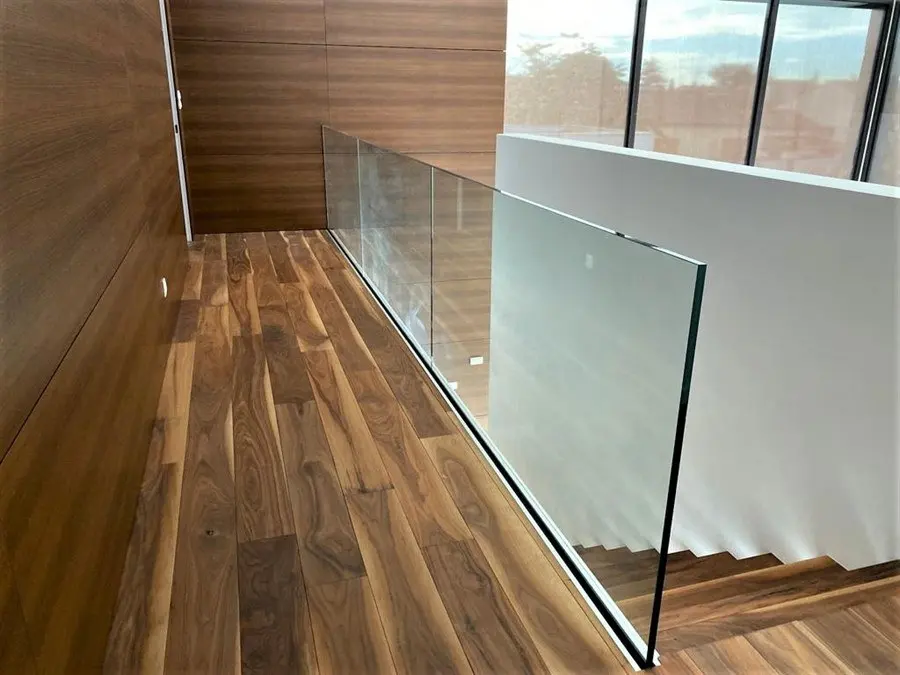
A glass balustrade keeps you safe without blocking the view: that is why it is chosen on a terrace facing İzmir’s sea and sunsets, on a staircase that gathers light, or on a modern façade. But a glass balustrade is not “just glass”: glass type, thickness, fixing system, anchoring and installation detail together decide safety. This guide covers the system types, glass choice, handrail, dimensions, the effect of the coast, cleaning and what drives price.
Short answer: Three things decide a glass balustrade: (1) the right glass (laminated toughened, thickness calculated), (2) a suitable system and strong fixings (clamp, channel or side fixing; stainless hardware), and (3) correct measuring, anchoring and drainage with clean installation. The handrail, height and coastal conditions also count; the price is the sum of these items.
Glass balustrade systems: which one, and where?
| System | How it works | Character | Points to watch |
|---|---|---|---|
| Clamp (point fixing) | Glass held by stainless fittings | Looks light, quick to fit | Hole and clamp detail, glass thickness |
| Channel (base-shoe) system | Glass sits in a base channel and is fixed | Frameless, clean and strong look | Channel planned in advance, drainage |
| Side (fascia) fixing | Glass attached to the edge of the slab | No floor area lost | Edge thickness, anchoring |
| Framed glass infill | Glass inside a metal frame | More economical, classic look | Frame paint, appearance |
| Glass + metal combination | Glass panels with steel or stainless bars | Different designs | Joint details |
| Stair glass balustrade | Fixed to treads or a side beam | Light and airy | Slope, handrail, fixings |
You can see our work on the railings and glass products pages and in the gallery.
Choosing the glass: safety starts with the glass itself
- Toughened glass: heat-treated for strength; when it breaks it crumbles into small, non-sharp pieces.
- Laminated glass: two or more panes bonded with a film; if it breaks the pieces stay in place and the risk of falling is lower.
- Laminated toughened: the safest and commonest choice for balustrades; broken glass does not fall and the panel stays up for a time.
- Thickness: calculated from span, height, system and loads; ask for it in writing and do not guess.
- Glass edges: should be ground and polished; edge flaws lead to breakage.
- Heat-soak testing: worth asking about for toughened glass to reduce the rare risk of sudden breakage.
- Privacy: frosted, printed or translucent options control sight lines.
Product and test standards exist for glass in balustrades (for example TS EN 12150 for toughened glass, TS EN 14449 for laminated safety glass and TS EN 12600 for impact testing); ask for the glass documents and specifications in the quote.
Height, handrail and gaps
- Height: about 100 cm and above is common on home balconies and terraces; stair handrails are around 90 cm. Exact values depend on building type and regulations.
- Handrail: protects the top edge of the glass, gives a grip and completes the line visually. It is essential on stairs. Near the sea, stainless steel (316) is preferred.
- Gaps: gaps between panels and at the bottom edge should be limited for children (no more than about 10–11 cm).
- Children: a glass panel is harder to climb than horizontal bars and is much safer.
For general railing safety see our steel railing guide.
Fixings and anchoring: the real strength of a balustrade
Even strong glass fails if the fixing is weak:
- Slab and edge: concrete quality, edge thickness and distance from the edge determine the anchor choice.
- Anchor type: chemical anchors, steel plugs or welded plates, suited to the floor.
- Load calculation: horizontal loads (leaning, crowds, push) must be calculated for the type of use.
- Glass–metal contact: glass must not touch metal directly; use gaskets and spacers.
- Drainage: water must not collect in a channel system; standing water causes rust and glass-edge damage.
İzmir’s climate and sea air
- Coastal areas (for example Karşıyaka, Bayraklı, Narlıdere, Güzelbahçe, Urla): salt makes grade-316 stainless hardware and proper surface protection necessary; glass needs washing more often.
- Inland areas (for example Buca, Bornova, Gaziemir): less salt; dust and rain marks still appear.
- Sun and heat: glazed surfaces heat up; consider shade and daytime use.
- Wind: on high floors and open ground, wind load affects glass thickness and anchoring.
Installation: a game of detail
- Site measuring is essential: slopes, level differences, edge condition and corners cannot be taken from a photo.
- Floor works: screed, tiling and waterproofing must be planned with the balustrade detail; this is critical for channel systems.
- Glass ordering: glass is cut and processed to size; if the measurement is wrong the glass is remade, so no order is placed before the measurements are final.
- Handling and lifting: glass is heavy; on high floors a crane, vacuum lifter or hoist may be needed.
- Testing: after installation, check solidity, alignment and edge gaps.
Glass balustrade or glazed balcony: the same thing?
No. A glass balustrade is an open safety element at the edge of a balcony or terrace that prevents falls. A glazed balcony encloses the balcony with glass, which changes the look and usable area of the building and, in apartment blocks, usually involves an owners’ board decision and zoning rules. If you are considering a façade change, get written information from the municipality and building management.
Cleaning and maintenance
- Regular cleaning: wipe glass and handrail regularly; salt builds up on the coast.
- Soft cloth and glass cleaner: avoid abrasives to prevent scratching.
- Hardware: check clamps, screws and anchors once a year; signs of rust call for early action.
- Channel and drainage: keep the drainage in the base profile open.
- Cracked or chipped glass: replace immediately; cracked glass is not safe to use.
What determines the price?
- Glass type and thickness: laminated toughened, frosted or printed, heat-soak testing.
- System: clamp, channel, side fixing or framed.
- Handrail and fixing materials: stainless grade, number of fittings.
- Length and corners: total run, number of corners and returns.
- Installation conditions: height, access, floor preparation, crane need.
- Extra works: making good and re-waterproofing the floor.
A “per-metre glass balustrade price” is misleading on its own; separate lines in the written quote make comparison easier. For the same logic see our railing prices article.
Common mistakes
- Choosing non-laminated glass: pieces may fall when it breaks.
- Setting thickness by guesswork: using thin glass without calculation.
- Weak anchoring: strong glass with a weak fixing still fails.
- Skipping the handrail: a loss of safety and comfort, especially on stairs.
- Unsuitable hardware on the coast: clamps and screws rust quickly.
- Measuring from a photo: glass cut to the wrong size has to be remade.
- Forgetting drainage: water collects in the channel.
8 questions to ask when requesting a quote
- What are the glass type, thickness and treatment (laminated, toughened, frosted); are there documents?
- Which system (clamp, channel, side fixing) and what fixing detail?
- What are the handrail and hardware materials (stainless 304 or 316)?
- What anchor type and load calculation are used?
- How are drainage and compatibility with floor waterproofing resolved?
- Who measures, who installs?
- Does the quote include glass, transport, lifting and installation?
- What warranty, maintenance advice and after-sales support are offered?
The process with Ertürk Metal
- Discussion and photos: you send photos of the terrace or stairs and approximate dimensions.
- Site measuring: edges, floor, corners and height are measured.
- Design and quote: system, glass, handrail and hardware are settled and a written quote is prepared.
- Manufacture: metal parts are made in our workshop in Buca; glass is prepared to size.
- Installation and handover: our team installs, checks and hands over on site.
Manufacturing time depends on the system and glass supply; a firm time is given in writing once measurements and model are settled.
Ertürk Metal in İzmir and across Türkiye
Since 2007 Ertürk Metal has made glass and steel railings, staircases, doors and metal structures in its workshop in Buca, İzmir. Across Türkiye our own team measures, delivers and installs. We also ship to France and install within roughly 200 km of Béziers. See our service areas page.
Send a photo of your terrace or staircase and approximate dimensions through our contact page, on WhatsApp or by phone, and we will settle the system and glass options together.
Conclusion
A good glass balustrade is the meeting of the right laminated toughened glass, strong fixings, stainless hardware and well-resolved drainage. Before you decide, ask in writing for the glass type, thickness, system and anchoring; that is what it takes to feel safe while enjoying İzmir’s views.
Related articles: Steel Railing Guide for İzmir · Steel Staircase Guide for İzmir · Railing prices in İzmir
Frequently asked questions
Is a glass balustrade safe?
Yes, with the right glass and the right system. Laminated toughened glass is preferred: toughening gives strength, and the laminate film keeps the pieces in place even if it breaks. Glass thickness, fixing and anchoring must be calculated for the span and loads.
Which type of glass should be used?
Laminated and toughened glass. Thickness and number of layers depend on the system, span and height; ask for them in writing. To reduce the rare risk of spontaneous breakage in toughened glass, ask whether the glass has been heat-soak tested.
What is the difference between clamp, channel and side-fixed systems?
In a clamp system the glass is held at points by stainless fittings and looks light. In a channel (base-shoe) system the glass sits in a channel along the base, giving the cleanest, strongest frameless look, but the channel must be planned in advance. A side-fixed system attaches the glass to the edge of the slab and does not use floor area. The right one depends on the floor, the edge and the budget.
Does glass get dirty easily, and how is it cleaned?
Glass shows dust, salt and water marks; on the coast it needs washing more often. Wipe with a soft cloth and glass cleaner; avoid abrasives. Good drainage and no standing water in the base profile reduce staining.
Is a handrail necessary?
It is recommended in most installations for safety and comfort and is essential on stairs. The handrail protects the top edge of the glass and gives a grip. Near the sea, stainless steel (grade 316) is preferred.
What determines the price?
Glass type and thickness, the system (clamp, channel, side fixing), handrail and fixing materials, length and number of corners, privacy treatment (frosted, printed), installation height and floor preparation. A per-metre price alone is misleading; items should be listed separately.
Do you build glass balustrades outside İzmir or for France?
Yes. We manufacture in our workshop in Buca, İzmir. Across Türkiye our own team measures, delivers and installs. We also ship to France and install within roughly 200 km of Béziers.