The entrance door is the first to welcome and the first to defend a home: security, heat and sound insulation, appearance and daily comfort all meet in this one element. In İzmir, from apartment flat to detached villa, the steel entrance door is one of the most chosen solutions for its strength and design variety. But two doors that look the same perform very differently depending on leaf, lock, frame, insulation and fitting. This guide covers those differences, dimensions, cladding and design options, insulation, installation and what drives price.
Short answer: Three things decide a steel entrance door: (1) the security system (strong leaf and reinforcement, multi-point lock, frame and wall fixing), (2) insulation and resistance to the weather (infill, seals, threshold; cladding and surface protection), and (3) correct measuring and clean installation. Design (laser-cut, glazed, timber-clad) sets the look; the price is the sum of these items.
Types of entrance door: which one, and where?
| Type | Where it is used | Character | Points to watch |
|---|---|---|---|
| Steel apartment door | Flats | Security, sound insulation, standard size | Lock, frame fixing, sound insulation |
| Steel villa entrance door | Detached houses, villas | Wide, designed, secure | Weight, hinges, weather |
| Glazed entrance door | Businesses, offices, entrance lobbies | Light, modern look | Safety glass, thermal insulation |
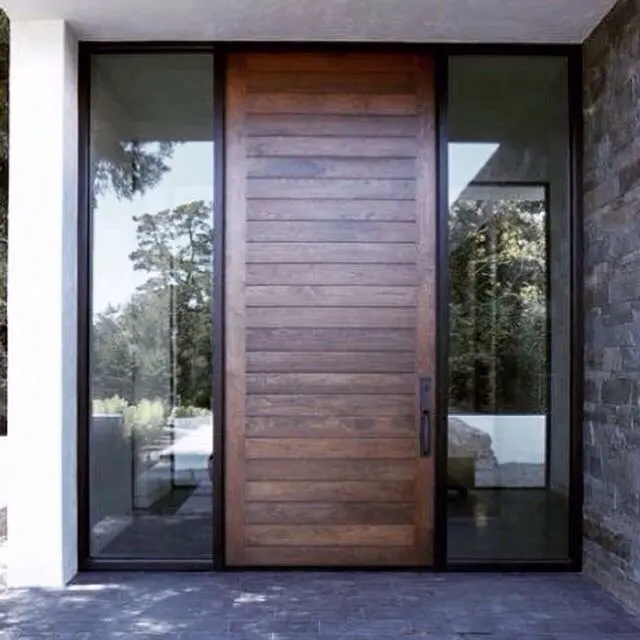
| Side-light door | Villas, apartment entrances | Light and appearance | Glass-to-frame junction |
| Pivot door | Wide, modern entrances | Impressive, large | Pivot and weight calculation |
| Laser-cut patterned door | Villa entrances | Distinctive pattern, light and shadow | Plate thickness, frame, paint |
| Timber-clad steel door | Entrances wanting a warm look | Steel security + timber look | Upkeep on the façade |
You can see our range on the entrance doors page and examples in the gallery. For gate choice and general door selection see our metal door guide.
Security: a door is a system
The security of an entrance door comes not from a single part but from parts working together:
- Leaf and reinforcement: plate thickness, internal frame and reinforcement decide resistance to forcing.
- Lock system: a multi-point lock and quality cylinder; the lock holds at the edges as well as one point.
- Frame and wall fixing: if anchoring and fixing are weak even the strongest door can be forced out; the frame must be fixed to the wall properly and at enough points.
- Hinges and protection plates: the hinge side is often neglected; quality hinges and anti-removal pins matter.
- Resistance class: if a specific burglar-resistance level is wanted (for example the “RC” classes in TS EN 1627), ask for it in writing with documents.
- Viewer and camera: a way to see outside from behind the door should be planned in advance.
Important: Security level is the sum of the parts. Ask in writing for the leaf structure, lock system, frame fixing and (if wanted) resistance-class documents.
Heat and sound insulation
- Infill: the material inside the leaf holds heat and sound.
- Seal system: the gaskets around the door determine air, water and sound tightness.
- Threshold: the bottom detail stops wind and rain; critical on an external door.
- Apartment door: sound insulation stands out; seals and infill matter for neighbour and stair noise.
- External door: heat loss and water ingress need frame, threshold and seals considered together.
- Frame-to-wall gap: sealing it properly with foam and insulation prevents thermal bridges.
Cladding, design and colour
- Painted finish: matt, satin or textured; anthracite, black and grey stand out in contemporary architecture.
- Timber cladding: a warm look; on an exterior façade protective varnish and overhead shelter matter against sun, rain and damp.
- Laser-cut patterns: leaf, geometric or bespoke designs; a glass or plate layer behind can add security and privacy.
- Glazed and side-light models: let light in; safety (laminated) glass and thermal insulation matter.
- Colour match: matching the façade, windows, railings and garden gate gives the entrance unity. You can carry the same line into railings and garden gates.
Measuring and the frame: site measuring is essential
If the door is made to size, a small error means remaking it:
- Wall opening: width, height, wall thickness and plumb are measured.
- Floor level: level differences are taken to match the threshold and floor finish (tile, marble).
- Opening direction: in or out, decided by space and security.
- Frame type: frame depth and the plaster condition of the wall affect the fitting type.
- Standard or custom size: apartment doors are usually standard; villa and older-building entrances need custom manufacture.
İzmir’s climate and protecting the entrance
- Coastal areas (for example Karşıyaka, Bayraklı, Narlıdere, Güzelbahçe, Urla): salt and damp call for galvanising or a durable primer and quality powder coat on exterior doors, and corrosion-resistant hardware.
- Inland areas (for example Buca, Bornova, Gaziemir): sun and rain still stress the surface; the surface system matters.
- Sun: dark colours heat and fade; timber cladding needs protection from the sun.
- Sheltered entrance: a door under an eave or canopy lasts longer. See our pergola and canopy guide.
Installation: where the door’s strength shows
- Frame fixing: the frame is anchored to the wall at enough points with proper anchors; plumb and square are set.
- Frame-to-wall fill: closed with foam and insulation to prevent thermal bridges and air leaks.
- Leaf adjustment: the leaf must close flat without rubbing, and the lock must work smoothly.
- Plaster and finishes: plaster, paint and flooring after installation should finish neatly around the frame.
- Testing: lock, hinges, seals and threshold are checked.
Having the team that measures and makes the door also install it reduces the risk of error.
Apartment and complex entrances: what to watch
- External façade changes: in an apartment block or complex, a change that alters the external look may need an owners’ board or management decision.
- Fire and escape: doors opening onto communal areas must also be checked against fire and escape rules.
- Fire-resisting doors: need special testing and certification; not every steel door is fire-resisting.
- Accessibility: threshold and clear width should be suitable.
What determines the price?
- Door size: standard or custom; wide and pivot doors need more material and hardware.
- Leaf and reinforcement: plate thickness, frame and reinforcement.
- Lock and hardware: multi-point lock, cylinder quality, handle and hinges.
- Insulation: infill material, seals and threshold.
- Cladding and colour: paint, timber cladding or special finish.
- Design: laser-cut, glass, side light, fanlight.
- Frame and installation: frame type, wall condition and access.
Two quotes of the same size can differ greatly because of content, so the items should be written out. The same approach is in our metal door prices article.
Common mistakes
- Looking only at price: a cheap door trims leaf, lock or seals.
- Not asking about frame-to-wall fixing: the weakest link in security.
- Putting timber cladding on an unprotected exterior façade.
- Estimating measurements: the frame does not fit and the plaster is damaged.
- Neglecting insulation: seal and threshold detail overlooked.
- Leaving a weak frame behind a laser-cut pattern.
- Forgetting floor level: threshold and floor finish clash.
8 questions to ask when requesting a quote
- What are the leaf plate and reinforcement structure?
- What are the lock system, cylinder and hardware?
- How many points and with what anchors is the frame fixed to the wall?
- How are heat and sound insulation (infill, seals, threshold) resolved?
- What are the cladding, colour and surface protection (galvanising/primer, paint, number of coats)?
- Who measures and who installs?
- Does the quote include transport, installation and touch-ups?
- What warranty, maintenance advice and after-sales support are offered?
The process with Ertürk Metal
- Discussion and photos: you send photos of the entrance, approximate dimensions and your wishes.
- Site measuring: wall opening, floor level, opening direction and surroundings are assessed.
- Design and quote: model, cladding, lock and insulation options are settled and a written quote is prepared.
- Workshop manufacture: the door is made in our workshop in Buca and the surface treatment is applied.
- Installation and handover: our team installs, adjusts, checks and hands over on site.
Manufacturing time depends on the model and workload; a firm time is given in writing once measurements and model are settled.
Ertürk Metal in İzmir and across Türkiye
Since 2007 Ertürk Metal has made entrance doors, garden gates, railings, staircases and metal structures in its workshop in Buca, İzmir. Across Türkiye our own team measures, delivers and installs. We also ship to France and install within roughly 200 km of Béziers. See our service areas page.
Send a photo of the entrance and approximate dimensions through our contact page, on WhatsApp or by phone, and we will settle model, cladding and security options together.
Conclusion
A good steel entrance door is the sum of a strong leaf and lock, a firm frame fixing, correct insulation, a surface suited to the climate and clean installation. Before you decide, ask in writing for the leaf, lock system, frame fixing and insulation detail; your home’s security and comfort are hidden in these details.
Related articles: Metal Door Guide for İzmir · Metal Door Prices · Motorised Sliding Gate Guide
Frequently asked questions
What makes a steel door secure?
Security comes from the whole system, not one part: the leaf plate and reinforcement, the lock system (multi-point lock, quality cylinder), the frame and its fixing to the wall, and the hinges and protection plates. A weak frame-to-wall connection makes even the strongest door insecure. If a specific resistance class is wanted (for example the 'RC' classes of TS EN 1627), request it in writing with documents.
Does a steel door give heat and sound insulation?
Yes, but it depends on the leaf infill, the seal system, and the threshold and frame detail. On an external door, seals and threshold matter most; on an apartment door, sound insulation stands out. Ask about the infill and seals in the quote.
Which models are popular for villa entrances?
Wide and pivot doors, models with side lights and glazing, and laser-cut or timber-clad steel doors are common. The choice depends on architecture, light, privacy and security. Large, heavy doors need hinge or pivot calculations.
Does a timber-clad steel door last on an exterior façade?
Sun, rain and damp wear timber cladding; on an exterior façade the type of cladding, protective varnish and overhead shelter matter. It does well in sheltered entrances; in the open it needs more frequent upkeep, or a painted surface may be better.
Is a laser-cut patterned door secure and durable?
Durability depends on plate thickness, pattern density, the internal frame and surface protection. The larger the pattern, the stronger the frame must be, and cut edges should be painted. For security a glass or plate layer can be added behind.
Are door sizes standard, or are custom sizes made?
Standard sizes exist, but custom sizes are made for villa entrances, older buildings and special designs. The wall and frame must be measured on site.
What determines the price?
Door size, leaf and reinforcement structure, lock and hardware, insulation infill, cladding and colour, glazing and side lights, laser-cut detail, frame and installation conditions. Two quotes of the same size can differ because of content, so the items should be written out.
Do you build entrance doors outside İzmir or for France?
Yes. We manufacture in our workshop in Buca, İzmir. Across Türkiye our own team measures, delivers and installs. We also ship to France and install within roughly 200 km of Béziers.