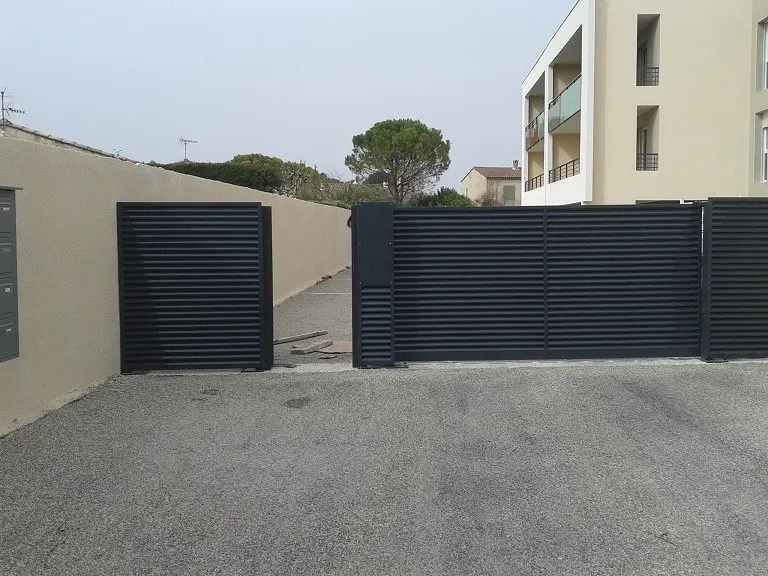
Arriving home and having the gate open at the touch of a button is one of the most practical comforts of daily life. A motorised sliding garden gate is one of the most chosen solutions, especially in İzmir’s densely built streets and detached homes where the entrance is narrow or the front space limited. But even a handsome gate gives trouble quickly if the motor power, the track or foundation quality, the safety equipment or the side-clearance plan is wrong. This guide covers system types, side clearance, motor and safety, foundations and slope, installation, maintenance and what drives price.
Short answer: Three things decide a motorised sliding gate: (1) the right system (track or cantilever) with enough side clearance, (2) a motor suited to the weight of the gate plus safety equipment such as photocells, a safety edge and an emergency release, and (3) strong foundations, posts and accurate measuring. The gate model decides the look; these three decide how it works; the price is the sum.
Sliding gate systems: track or cantilever?
| System | How it works | Strength | Points to watch |
|---|---|---|---|
| Track sliding gate | Gate slides on a rail in the ground | Economical, common | Rail collects debris, dust and water; slope; noise |
| Cantilever (trackless) sliding gate | Gate slides on a supporting beam with no ground rail | Clean, quiet, open ground | Strong foundation, more side clearance for the tail |
| Telescopic / bi-parting sliding | Gate slides in two parts | Less side clearance | Complex mechanism, upkeep |
| Automated swing (double-leaf) gate | Leaves opened by motors | Classic look | Opening space, ground slope |
| Integrated pedestrian gate | Separate walk-through door in the gate | Practical for daily use | Lock and hinge quality |
You can see our range on the garden gates page; see our garden gate models article (Turkish) for model ideas.
Side clearance: the most forgotten calculation
When open, a sliding gate has to slide its own length to one side:
- Track gate: side clearance is usually about the opening width.
- Cantilever gate: because of the counterbalance tail, side clearance is usually about 1.4–1.5 times the opening.
- Obstacles: that space must be free of trees, utility poles, fences, projecting parts and rising ground.
- Planning: the garden fence and wall should be designed so this distance is left beside the gate.
If clearance is insufficient, a swing or telescopic system is considered. For fence design see our metal garden fence guide.
Motor and controls: size the power to the gate
- Motor power: chosen for gate weight (kg), width and daily use; a weak motor wears out early.
- Rack-and-pinion drive: the motor turns a pinion along a toothed rack fixed to the gate; correct alignment gives quiet, long-lasting operation.
- Control options: remote, wall button, keypad, fingerprint or smartphone app.
- Battery back-up: the gate keeps working in a power cut; an emergency manual release should still be provided.
- Solar power: a solar panel option can be considered where running a mains cable is hard.
Safety equipment: a necessity, not an extra
A motorised gate is a powerful machine, with crushing and impact risks:
- Photocells (light beams): stop or reverse the gate if there is an obstacle in its path.
- Safety edge: stops the gate if it touches something.
- Flashing lamp: warns people the gate is moving.
- Obstacle detection: the motor stops or reverses if it senses resistance.
- Emergency manual release: to open the gate by hand in a power cut.
- Standards: product and operating-safety standards for motorised gates (such as TS EN 13241 and TS EN 12453) require crushing and impact forces to be limited.
Important: Ask that this equipment is listed in writing in the quote. It is essential wherever there are children and pets.
Foundations, posts and slope: what keeps the gate working
- A strong foundation for a cantilever gate: the supporting beam and counterweight sit on a concrete footing; an inadequate footing makes the gate sag.
- Posts: gate posts should be stronger than fence posts.
- Ground and slope: on level ground a sliding gate runs easily; on a slope it can drift or overload the motor. Slight slopes can be solved; steeper slopes may need another system.
- Drainage: on a track system water and mud must not collect in the rail; a cantilever gate leaves the ground clear.
- Power line: underground cable and fuse for the motor and controls should be planned in advance.
Gate model: looks and wind
- Slatted and louvred: both privacy and airflow; moderate wind load.
- Solid plate: full privacy but high wind load; needs strong foundations and motor.
- Laser-cut patterned: distinctive design; plate thickness, pattern density and edge paint matter.
- Bars: looks light, little wind load; bar spacing should be limited for child safety.
- Weight: the heavier the gate, the stronger the motor and foundation must be.
İzmir’s climate and location
- Coastal areas (for example Karşıyaka, Bayraklı, Narlıdere, Güzelbahçe, Urla): galvanising plus powder coat (duplex), stainless hardware and protection for the motor; more frequent upkeep.
- Inland areas (for example Buca, Bornova, Gaziemir): less salt; damp and dust affect the rail and motor.
- Narrow streets and dense housing: a sliding gate is an advantage because it does not swing outward; side clearance then governs the design.
- Sun: dark paint fades; electronics should be shaded and protected.
Permissions and neighbours
- Zoning: plan notes may cover garden wall and gate height, how it opens and the road-facing side.
- Opening onto the street: a gate should not swing over the road or pavement; a sliding gate has an advantage here.
- Complexes and apartment blocks: a management decision may be needed for external and communal changes.
- Neighbour boundary: if the gate and fence are on the boundary, get written agreement from the neighbour.
Installation and commissioning
- Site measuring: opening, side clearance, ground levels, slope and obstacles are measured.
- Foundation and posts: the concrete is left to cure; posts are set plumb and aligned.
- Gate and motor installation: the gate is placed, motor and rack aligned and end limits set.
- Safety equipment: photocells, safety edge and flashing lamp are connected; obstacle detection is tested.
- Controls and instruction: remotes are introduced, the emergency release is shown and care advice is given.
The electrical connection should be made by a qualified electrician.
Maintenance and common faults
- Once or twice a year: clean and lubricate the rail or supporting system, check the rack, tighten screws and anchors, and test the photocells and safety edge.
- On the coast: wash and check more often.
- Warning signs: a gate that slows, stops halfway, makes noise, ignores the remote or goes out of line needs early attention.
- Do not force it: a motorised gate carries a crushing risk; report faults to a qualified team.
What determines the price?
- Gate size and weight: width, height, plate thickness and model.
- System: track or cantilever; a cantilever needs a stronger support.
- Motor and controls: motor power, make, number of remotes, smart and solar options.
- Safety equipment: photocells, safety edge, flashing lamp and emergency release.
- Foundations and posts: footing size, number and section of posts.
- Pedestrian gate and fence: integrated pedestrian gate and fence match.
- Surface treatment and installation: galvanising and powder coat, access and power line.
A single “sliding gate price” is misleading; items should be separate lines in the written quote.
Common mistakes
- Not calculating side clearance: the gate has nowhere to open.
- Choosing a light motor: it wears out quickly on a heavy gate.
- Skipping safety equipment.
- Neglecting the foundation: a cantilever gate on a weak footing sags.
- Ignoring slope: the gate drifts by itself.
- Making gate posts as weak as fence posts.
- Leaving the power line to the end.
8 questions to ask when requesting a quote
- Is the system track or cantilever; how many metres of side clearance are needed?
- What are the gate’s weight and the motor’s power and make?
- Are safety devices (photocells, safety edge, flashing lamp, obstacle detection) included?
- What are the emergency release and back-up battery options?
- What are the foundation, post and anchor details?
- What are the surface treatment and paint system (number of coats)?
- Who measures, installs and commissions?
- What warranty, maintenance and after-sales support are offered?
The process with Ertürk Metal
- Discussion and photos: you send photos of the entrance, approximate dimensions and your needs.
- Site measuring: opening, side clearance, ground and slope are measured.
- Design and quote: system, model, motor and safety are settled and a written quote is prepared.
- Workshop manufacture: gate and posts are made in our workshop in Buca and the surface treatment is applied.
- Installation and commissioning: our team installs the foundations, gate and equipment, tests and hands over.
Manufacturing time depends on the gate type and workload; a firm time is given in writing once measurements and model are settled.
Ertürk Metal in İzmir and across Türkiye
Since 2007 Ertürk Metal has made garden gates, fences, railings, staircases, doors and metal structures in its workshop in Buca, İzmir. Across Türkiye our own team measures, delivers and installs. We also ship to France and install within roughly 200 km of Béziers. See our service areas page.
Send a photo of the entrance and approximate dimensions through our contact page, on WhatsApp or by phone, and we will settle system and model options together.
Conclusion
A good motorised sliding gate is the combination of the right system and side clearance, a motor matched to the gate’s weight, complete safety equipment and a strong foundation. Before you decide, ask in writing for the side clearance, motor power, safety equipment and foundation detail; for a system you will use every day, this is the best investment.
Related articles: Metal Garden Fence Guide for İzmir · Metal Door Guide for İzmir · Motorised Shutter Guide for İzmir
Frequently asked questions
Sliding gate or swing (double-leaf) gate?
A sliding gate needs no clear space in front to open, which suits narrow entrances and sloping approaches, but needs about the gate's length of clear space beside it. A swing gate has a classic look and needs space for the leaves to open. Space, ground slope, appearance and budget decide.
Track or cantilever (trackless) sliding gate: which is better?
On a track system the gate slides on a rail in the ground; it is economical but the rail can collect debris, dust and water. A cantilever gate slides on a supporting beam with no ground rail; it is cleaner and quieter but needs a strong foundation and more side clearance for the counterbalance tail. Choose by ground, slope and tidiness expectations.
How much side clearance does a sliding gate need?
Roughly the opening width for a track gate, and about 1.4–1.5 times the opening for a cantilever gate because of its rear tail. The exact figure depends on the gate type and design; site measuring is essential.
Will the gate open if the power fails?
Properly installed systems have an emergency manual release (a key to unlock the motor). A back-up battery can be added. Ask in the quote how the emergency release works and whether a battery option exists.
What safety devices should a motorised gate have?
Photocells (light beams), a safety edge, a flashing lamp, obstacle detection and an emergency release. For motorised gates, product and operating-safety standards (such as TS EN 13241 and TS EN 12453) and limits on crushing and impact forces matter; ask for them in writing.
Can a gate slide on sloping ground?
Slope makes a sliding gate harder: it can run by itself or overload the motor. Slight slopes can be solved; steeper ones may need a different system (a swing gate) or ground works. Always measure on site and take levels.
What determines the price?
Gate size and weight, system (track or cantilever), gate model (laser-cut, louvred, slatted, solid plate), motor power and make, safety and control equipment, foundations and posts, a pedestrian gate and installation conditions. Items should be separate lines in the written quote.
Do you build gates outside İzmir or for France?
Yes. We manufacture in our workshop in Buca, İzmir. Across Türkiye our own team measures, delivers and installs. We also ship to France and install within roughly 200 km of Béziers.